Behind the Words at the Counter: Judging Local Meat Beyond the Label
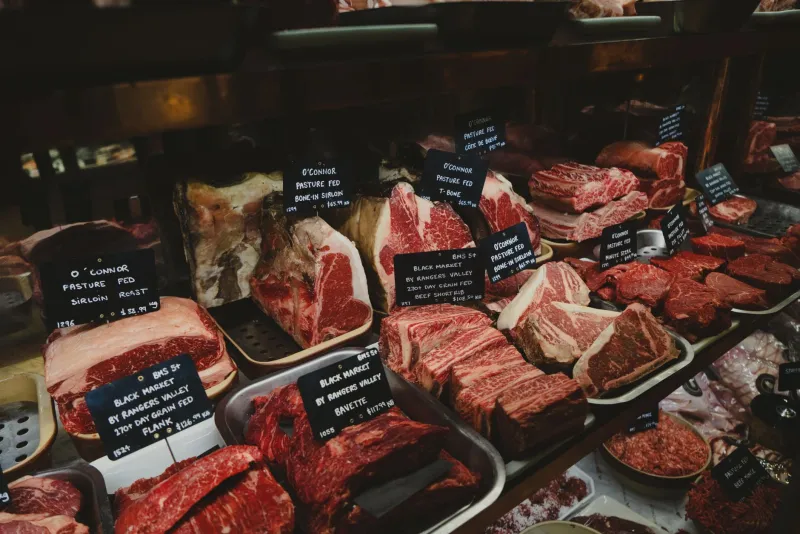
Walk into any butcher's shop in the country and you will find the same words on the same chalkboards: local, native breed, dry-aged, free-range. They are good words. They are also, with a few narrow exceptions, unregulated words, which means they can mean almost anything the person writing them wishes them to mean.
That is not an accusation. Most butchers use them honestly. But a customer has no way of telling one shop from another except by asking, and asking is a skill that is rarely taught. This is a short guide to acquiring it.
Local is a distance, not a standard
There is no legal definition of local. A shop may use it to mean a farm five miles away or a supplier in the next county; both are defensible. What matters is whether the shop can name the farm and the farmer, and whether the animal was both raised and finished there.
The distinction that catches people out is between rearing and slaughter. An animal born and raised in Devon but transported to a large abattoir several counties away is still, in some senses, local — but the provenance chain is longer than the chalkboard implies. Ask directly: where was it born, where was it raised, and where was it slaughtered? A good butcher answers without hesitation.
Native breed is a starting point, not a guarantee
Breeds such as Devon Ruby, South Devon, Gloucester, Large Black and Middle White carry genuine character — fat that renders properly, depth of flavour, slower growth. But a breed name on a label tells you nothing about how the animal lived or how the meat was handled afterwards.
A well-reared commercial cross will beat a poorly reared pedigree every time. Treat the breed as one piece of information among several, and be suspicious of any counter that offers an unusually rare breed at an unusually low price.
Dry-aged needs a number
The term ageing covers two quite different processes. Dry-ageing means the carcass or primal is hung in air, losing moisture and concentrating flavour, with a trim of the darkened exterior before sale. Wet-ageing means the meat is vacuum-packed and left in its own juices — perfectly sound, but a different thing entirely.
What the customer needs is a number. How long, and on the bone or in a bag? Twenty-one days on the bone for beef is a reasonable standard; twenty-eight to thirty-five is a serious commitment and should be reflected in the price. If a shop says aged but cannot say how long, the word is doing decorative work.
Free-range and outdoor-bred are not the same
Free-range implies genuine access to the outdoors for a meaningful part of the animal's life. Outdoor-bred means only that the animal was born outside; it may have spent most of its life indoors. Both terms are legitimate, but they are not interchangeable, and the second is frequently used to imply the first.
For pork and poultry, ask how long the animals spent outside and what they were fed. For lamb and beef, the more useful question is often about grass and finishing — whether the animal was grass-finished or given grain in its final weeks, which changes both the fat colour and the flavour.
Questions worth asking
A short list, useful at any counter:
- Which farm did this come from, and can you tell me about it?
- When was it cut, and was it hung, and for how long?
- Is this bone-in or boneless, and what is the approximate yield per portion?
- What would you do with this cut in my kitchen?
- Is there anything here you would steer me away from today?
That final question is the most revealing. A butcher with confidence in the stock will answer it plainly. A butcher selling whatever is in the window will find it difficult.
Reading the red flags
Several things should give a customer pause. Provenance reduced to British and nothing more, with no farm name, is the most common. Aged without a period is another. So is meat that looks pale, wet and slack, sitting in a tray of pink liquid — a sign of fast rearing, poor chilling or both.
Watch for frozen and thawed stock sold without notice, and for an unwillingness to talk about suppliers. Price is a signal too, in both directions: unreasonably cheap meat has usually had something removed from it along the way, whether welfare, age or trim.
Value is not the same as price
The ticketed figure per kilo rarely reflects what a joint costs to put on the table. A boneless joint at a higher price may be better value than a cheaper bone-in cut if the bone is heavy and the trim generous. A dry-aged joint loses moisture in the pan but gives back flavour; a wet one releases water and shrinks dramatically.
It helps to think in portions rather than kilos. A 2kg bone-in shoulder will feed six comfortably and yield stock from the bone afterwards. The same weight of lean loin may feed four, and will need more care to keep moist. Cheaper cuts are not a compromise — they are frequently the better buy, provided the animal behind them was worth eating.
The counter is a conversation
None of this requires expertise. It requires curiosity and a willingness to ask two or three plain questions of the person in the apron. A good butcher will welcome them; the answers are the whole point of the trade.
Labels are a summary, and summaries always lose something. The counter, the conversation and the look of the meat itself will tell you far more — and they cost nothing but a moment's attention.