Fat Cover, Orchard Fruit and Good Cider: Cooking West Country Pork as the Nights Draw In
There is a moment in late October when the light over the bay turns the colour of weak tea and the kitchen begins to smell of woodsmoke and fruit. That is the point at which pork comes into its own. It is a meat that rewards patience, and autumn is a patient season.
Pork has an unfortunate reputation in some quarters — dry, pale, something to be smothered. That reputation belongs to meat that was reared quickly and cooked to the point of ruin. Handled properly, with a decent layer of fat and a modest amount of heat over a generous amount of time, it is among the most forgiving things a home cook can put in the oven.
Begin with the cut, not the recipe
Four cuts do most of the work in an autumn kitchen, and each asks something different of you.
Shoulder is the braiser. Bone-in shoulder, somewhere between 1.5kg and 2.5kg, has enough internal fat and connective tissue to withstand three hours of gentle heat and come out spoonable. Boneless shoulder is easier to carve but cooks a little faster and dries at the edges; tie it firmly if your butcher has not already done so.
Belly is the most honest cut on the counter. It is fatty, it is cheap relative to its flavour, and it carries crackling better than anything else. Ask for it scored and, if you can, for the ribs to be taken out and handed over separately — they make a cook's perk of their own.
Loin is the roast for a Sunday, and the one most often ruined. It is lean, so it wants a shorter, hotter cook and a proper rest. Boned and rolled loin with the skin left on gives you both crackling and a neat slice.
Ribs are for the traybake and the table where people help themselves. A rack of six or eight, or a bag of individual ribs, will take a cider glaze beautifully.
What good fat cover tells you
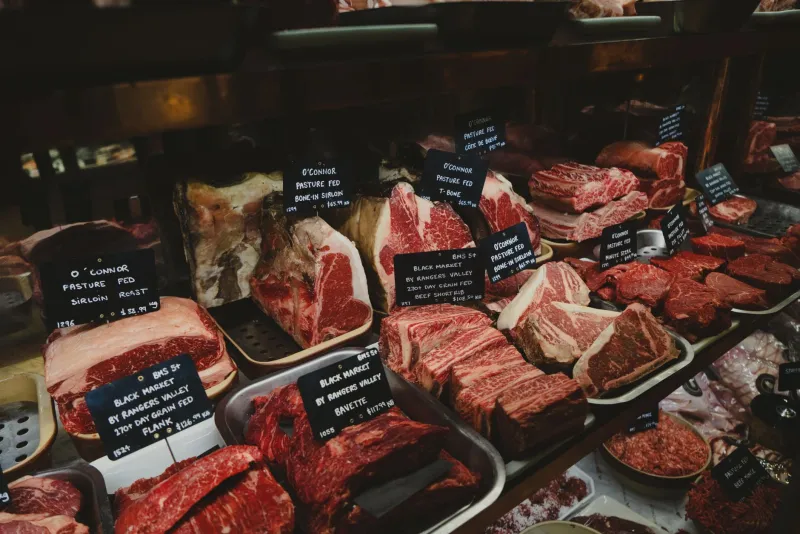
Before any of this matters, the meat has to be right. At the counter, look at the fat. On a loin or a shoulder you want a layer roughly 8mm to 12mm deep — enough to baste the joint from the inside as it cooks. It should be creamy white, firm and dry to the touch, not slack or yellowed.
The lean should be a deep, slightly dusky pink, not the washed-out grey-pink of pork reared indoors at speed. If the skin is present, it should be dry and evenly set, with no patchy dampness. And ask where the animal was born and raised, not merely where it was slaughtered — the two are not the same claim, and the difference shows up on the plate.
Cider and orchard fruit
West Country cider is the natural partner here, provided you choose the right one. A dry or medium-dry cider at around 5% to 6% will give acidity and a faint tannic grip. Sweet or fruit-flavoured ciders turn cloying once reduced; leave them for the glass. Roughly 500ml is enough for a shoulder, with a little in reserve to top up the pan.
Apples should be treated as two separate ingredients. Bramleys and other cooking apples collapse into a rough sauce that cuts through the fat — good with shoulder and belly. Eating apples such as Cox or Egremont Russet hold their shape and belong in a traybake, sliced thick and added late so they keep an edge. Pears work on the same principle and are gentler.
Sage is the herb of the season and the one that suits pork best, though it turns bitter if burnt. Tuck leaves under the skin rather than scattering them over a hot surface. Thyme, bay and a little mustard will do the rest of the work.
Braising shoulder and belly
For a bone-in shoulder of about 1.5kg to 2kg, set the oven to 160C (140C fan, Gas 3). Brown the joint thoroughly in a heavy casserole, lift it out, soften onions and apple in the fat, return the meat, add cider, a little stock and the sage, then cover and cook for three to three and a half hours. The joint is ready when a skewer passes through with no resistance at all — an internal temperature of about 90C is a useful check. Rest it, uncovered, for twenty minutes while you reduce the liquor.
Belly wants a two-stage approach. Cook it covered at 160C for around two and a half hours, then raise the oven to 220C (200C fan, Gas 7), uncover, and let the skin finish for twenty-five to thirty minutes. Dry the skin thoroughly beforehand and salt it generously; moisture is the enemy of crackling.
Roasting loin
For a boned and rolled loin of 1.2kg to 1.5kg, dry the skin, salt it, and roast at 220C (200C fan, Gas 7) for twenty minutes before dropping to 180C (160C fan, Gas 4) for a further forty-five minutes to an hour. Aim for 65C to 68C at the centre and rest for ten to fifteen minutes under foil. Slightly pink pork is safe, juicier and, we would argue, correct.
The weeknight traybake
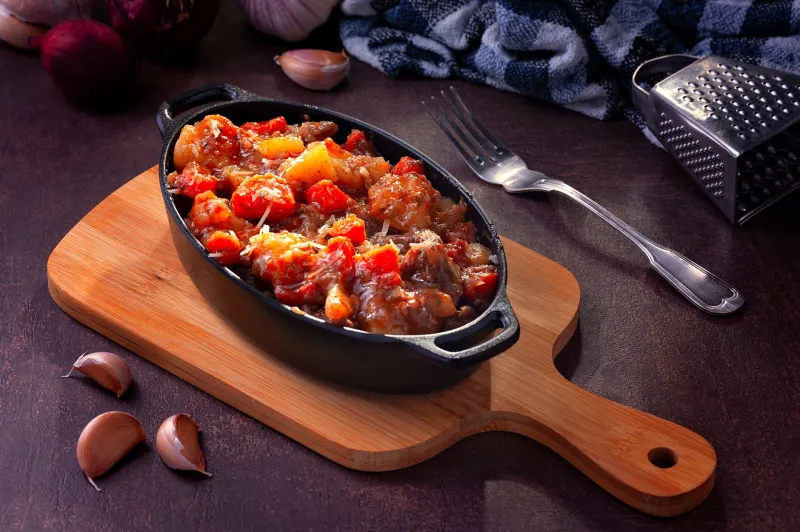
Cut belly or shoulder into thick strips, toss with sliced onion, halved potatoes, wedges of eating apple and a few sage leaves, add a splash of cider and a little oil, and roast at 180C (160C fan, Gas 4) for an hour and a quarter, turning once. It is not fine dining. It is the sort of dinner that makes a Tuesday bearable.
Carving notes
Always rest before carving, and carve across the grain rather than along it. A bone-in shoulder needs little more than a spoon; a loin should be sliced in fingers roughly 1cm thick, with the crackling taken off first and broken into shards. Ribs are portioned one bone per person for a starter, two for a main.
Buying well
Ask when the meat was cut. Ask for the farm name. Ask for fat cover rather than trim, and if a joint looks pale and wet with a puddle in the tray, walk on. Good pork is not the cheapest thing on the counter, but it is the one that will feed you properly — and in November, that is worth more than a few pence a kilo.